Excitement, Relationship: Keys for Reducing Youth Crime in Memphis
Engaging Memphis youth in activities they care about is critical, experts say
By: Victoria Smith, Markell Rogers and Georleshia Minter

Adults always tell 15-year-old Colton Allen that there are so many youth programs he could be involved in, but he and his teenage peers find many of them boring, hard to get to and uninviting. Without anything to do, and few financial resources in their family, young people are more likely to commit crimes.
“People fall into crime to make quick money,” he said.
And when crime seems to be commonplace, it’s hard for youth to see a way out, said Lakeisha Taylor, a teacher in Frayser.
“They walk out of their front door and see it every day,” she said.
And research shows that long-term exposure to violence is detrimental to children. They can be at an increased risk for all sorts of behavioral, psychological, and academic problems, according to the American Academy of Pediatrics. Youth who are frequently exposed to violence are also more likely to commit crimes and participate in alcohol and substance abuse.
In Memphis, youth crime only accounts for about 20% of total crime, and the overall youth crime rate has fallen in the past few years. But car break-ins and thefts are surging, and young people are committing more crimes with guns than ever.
This increase has prompted politicians, community leaders, and concerned citizens to search for solutions. Proposals range from mentorship, fining parents for their children’s crimes, creating more relevant youth programming, increasing police presence and changing gun policy.
The newly-elected City of Memphis Mayor Paul Young has promised to reduce overall crime by 10% annually and wants to implement successful community collaboration strategies from places like Omaha, Nebraska.
But if young people like Colton aren’t interested in those programs, it’s unlikely they will be effective.
Personal intervention
That’s why people like Gregory Washington, the director of the Center for the Advancement of Youth Development at the University of Memphis, seek to make interventions more relatable and study their effectiveness.
One of the initiatives he leads is a form of music therapy where youth come up with lyrics that express their emotions, especially related to past trauma. Research has shown that music therapy can help youth express feelings, manage stress, and improve communication.
“Music can be a hook for young people, to get them on the line,” he said. “You have to find ways to get young people to talk about what’s troubling them and their experiences and what they need to deal with in order to grow.”
An example of a music therapy setup. (Photo by: Ridvan Yumlu-Schiessl, Creative Commons)

Washington is also a big advocate for mentorship programs. Growing up in a middle-class family in Chicago, Washington recognized that he had many mentors and male role models in his life. When he became a child welfare social worker, he noticed most of the children he worked with lacked that.
“And so, I began to create these programs, first starting as gang prevention, but then turning into more rite of passage and culturally centered,” Washington said. “I always recruited young people like me to work for me and with me as well.”
Many organizations in Memphis have started mentorship programs to help youth reach their goals, including Knowledge Quest, MENTOR Memphis Grizzlies, and REACH Memphis.
Community organizations
Along with relationships with mentors, Memphians we spoke to believe strengthening young adults’ relationships with each other and their communities is critical for reducing violence. Policymakers have long looked to after-school programming to help reduce youth crime because FBI data has shown that youth crime peaks between 2 and 6 p.m.
Taylor said simple, enjoyable group activities like football, basketball and cheerleading are most effective at reducing crime. Often, she said, it’s out of boredom that youth “turn to the streets.”
Charles, an Orange Mound teenager, agrees. When he started participating in RedZone Ministries’ after-school programming six months ago, he didn’t know anyone there. But he’s quickly made numerous quality friends.
This is particularly important because many youth in the neighborhood turn to gangs if they’re left to find friends or protection on the streets, Charles said. And he knows all too well how disastrous the consequences can be.
A recent gang-related mass shooting stole the life of his cousin.
Along with building friendships, RedZone does a great job of restoring relationships that are fraying, Charles said.
“RedZone helps bring down the drama,” Charles said. “If kids got beef … they can talk to one of the staff, and the staff can help them communicate it out so nobody will get hurt.”
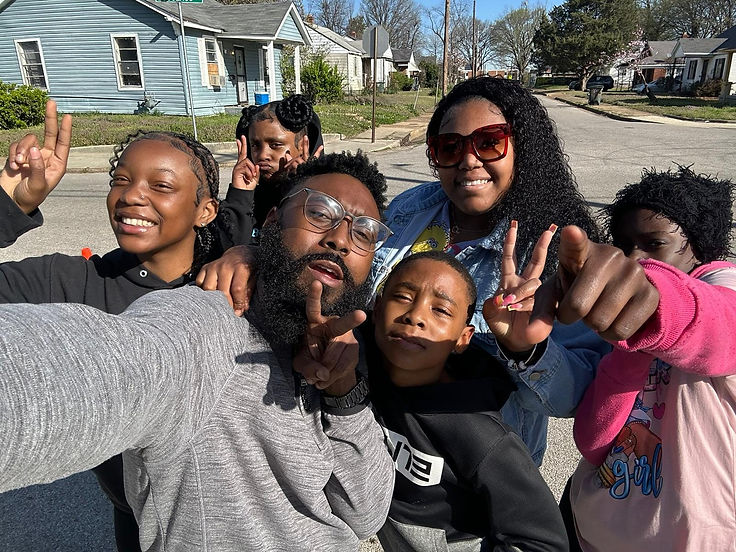
RedZone Ministries Men's Ministry Coordinator Lee Wilkins (center) poses with kids. Source: RedZone Minsistries
Lee Wilkins, RedZone’s Men’s Ministry Coordinator, said he and his colleagues take things like arguments and play fighting seriously.
“Normally, (play fighting) creates enemies,” Wilkins said. “We try to reduce (it) and … (help them) talk through their problems.”
On a daily basis, Wilkins said he’s just trying to meet kids where they are, showing them the love of Jesus and pushing them to care about each other and their own futures.
He and Charles are confident this work is making a difference.
Policy
Community centers also help youth by providing new learning experiences and teaching youth to use skills in the real world.
But community centers, unlike nonprofits, rely on local government funding. In Memphis, the city council has spent millions renovating some community centers, but Wilkins said the city could invest more.
Wilkins used an example from across the street from RedZone.
“Take the empty police vacant building in Orange Mound, and use it for police engagement for the community,” said Wilkins.
He said a strong way to build a safer community would be for youth to meet police officials when they’re not patrolling the neighborhood at night. Communicating with police would build trust and leverage into a community relationship. Being familiar with both parties are beneficial to the bigger picture, he said. They would understand the pressure of crime and relations on the residents.
Part of that pressure is the wide availability of guns being used in crimes.
In 2021, a Tennessee law allowed for adults to carry a handgun openly or concealed without a permit, making it one of the least strict gun laws in the nation.
Tennessee General Assembly Chambers
States with weaker gun laws have more violent crime, according to the Center for American Progress, a nonprofit policy institute. California has the strongest gun laws in the country compared to Tennessee, which ranks 29th.
There are an average of 14 gun deaths per 100,000 people in the United States compared to 20 in Tennessee and 8 in California.
But until those solutions are implemented, Taylor, the teacher in Frayser, said she has plans of her own. "I probably will start with getting to know the people in my neighborhood creating a network, a village where we can all rely and depend on each other and when we see something bad going on we can check in," she said. "Start from there."
